

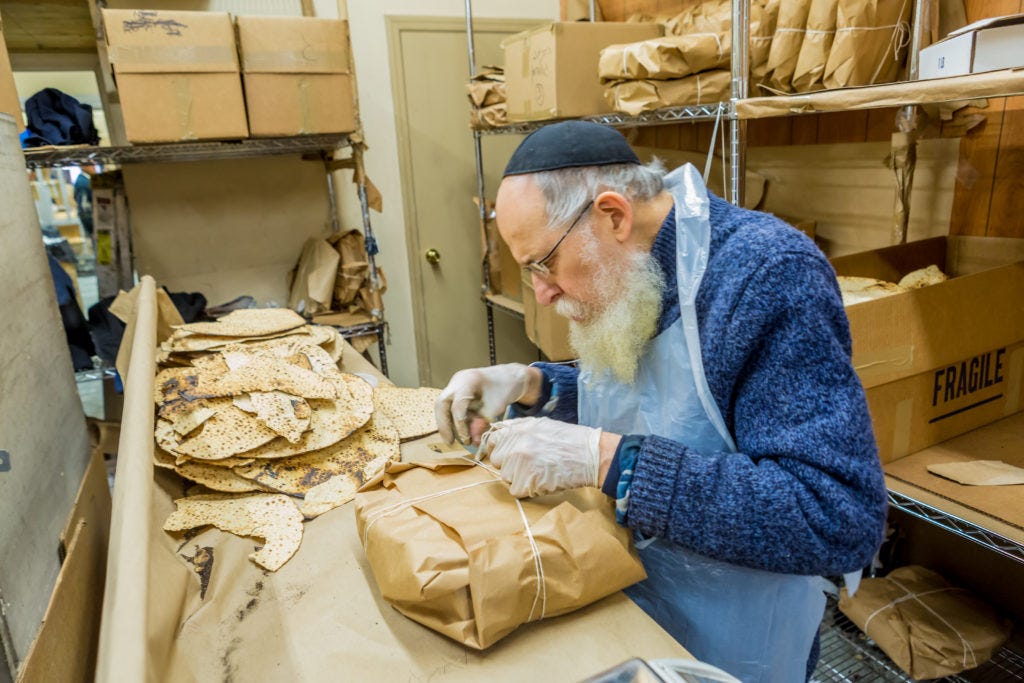
It’s 1:30 A.M. on the sixth night of Pesach.
You’re hungry, but there is nothing to eat. The leftovers are gone, your Pesach stash is running low… there’s only one thing left to do.
Matza.
There’s always Matza.
You go and amble over to the nearest open box of Matza you can find, fumbling around in the dark.
It’s just Matza. No need to turn the lights on.
You grab the box and bring it over to the sink, where you eat it to avoid getting crumbs everywhere, like a civilized person.
You eat the Matza over the sink knowing, somewhere in your soul, that this will truly fill you up. It is enough.
But you don’t want to eat only Matza. You would normally be eating the most delightful little secret snacks at 1:30 in the morning. But now you’re eating Matza, over the sink, like a civilized person.
A moment of genius strikes.
You amble over to the olive oil, and you bring it over to your Matza party by the sink. You pour a little on, still in the dark, hopelessly guessing as to how much you’re using.
The image of an Italian man you once met appears in your mind. He is proud of you for thinking of olive oil in your time of need.
Another thought – salt.
Salt?
Salt.
Salt and olive oil and now you’re in business.
Add the vinegar. Do it. Do it now.
You add the balsamic vinegar to your Matzah soaked in olive oil that you’re eating over the sink.
You put a little salt on it, then another layer of Matza.
You have created the Olive Oil Matza Sandwich.
All around the world, Italians can be found crying, screaming, throwing up. The very notion of an Olive Oil sandwich is absurd – but it’s the sixth night of Pesach, and you’re desperate.
It’s Matza and anything goes at this point.
In your mind, there’s a memory of a brightly colored piece of candy, a pastry, perhaps, the kind of thing you used to eat at this hour.
But all of those things seem like such delicacies now. You are stuck eating your bread of affliction, over the sink, like a civilized person, feeling far too accomplished for having put oil and vinegar on bread.
But that’s the miracle of Matza and the Pesach holiday. Eating this simple food, even for just eight days out of the year, reminds us of how lucky we are to be able to eat such wondrous things, at any hour of the day. Eight days of Matza would make even the biggest cynic grateful to live in such an abundant world.
The feeling lasts about as long as the last bits of Matza remain in your system. After that, we go back to taking our abundance for granted and fearing the approach of the next Pesach, but the Festival of Matza gives us that brief reprieve to experience true gratitude.
~
When I was younger, I didn’t understand Matza.
I still don’t, but at least know I understand that I don’t understand.
The world of Conservative Judaism that I come from tends to look at religious obligations as burdensome. Kashrut is a burden, Shabbos is a burden, but Pesach is the biggest burden of all.
Although we were Ashkenazi, many of us would eat kitniyot, items which Sefardic rabbis permitted for Pesach but not their Ashkenazi counterparts, because of a special “papal dispensation.” That was the joke we used to make.
Then, the Union of Conservative Judaism did actually give dispensation for all Conservative Jews to eat kitniyot in 2015.
As I have become more religious, I have stopped eating kitniyot.
But not for religious reasons. At least, not exactly.
I have stopped eating kitniyot out of my respect and admiration for Matza. But, to explain why, I have to tell you a bit of a long story.
It begins in 2022, in Crown Heights.
I had been teaching in a Yeshiva for about six months, and I had been learning about Torah and Mitzvot from my students. They convinced me that wrapping Tefillin was more important than basically anything else, and so, with some financial help from my Chabad rabbi, I purchased my first set and began wrapping.
In late March, I went to a Jewish teaching conference in Princeton, New Jersey. I met up with the Rebbetzin of the Princeton Chabad, and we caught up a little bit.
When I told her I was becoming more religious, she gushed with joy. She told me that while I was in New York, I should go to Crown Heights and check out 770 Eastern Parkway, the heart of the Chabad movement.

She asked a friend of hers to show me around. He took me to 770, where he taught me the full Shema (which I had never learned), to Gombo’s Heimiche Bakery, which has the best babka in the world (328 Kingston Ave, Brooklyn, NY 11213-4328, for anyone interested), and, finally, to a Matza Bakery.
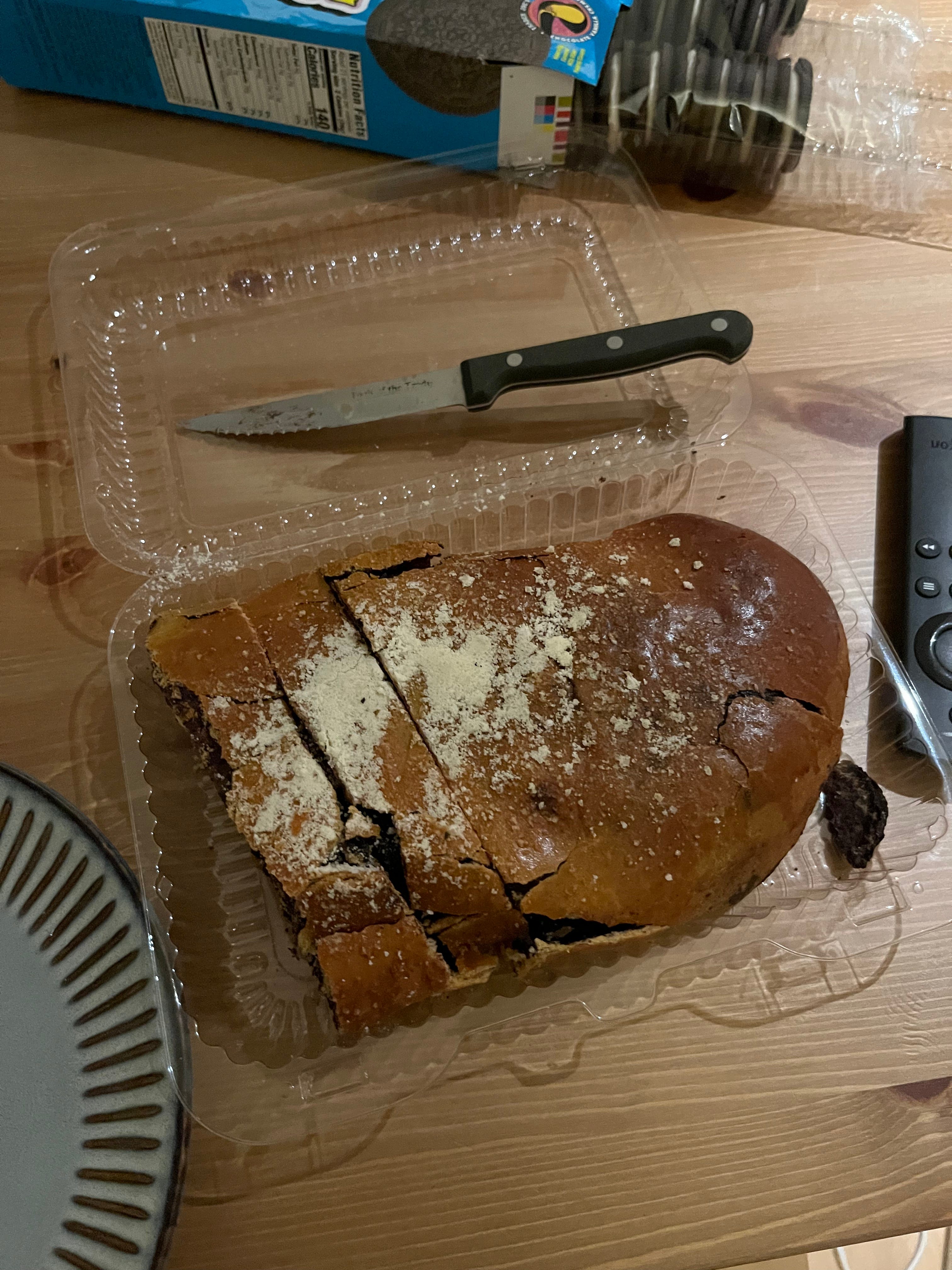
(The Babka in question.)
The Matza Bakery was on the first floor of an apartment building.
My guide explained that the bakery opened every fall, around October or November, and it ran day and night until the beginning of Pesach.
Families in the neighborhood could rent it out to bake their own Matzah. It seemed like a very fun tradition, complete with teenage boys breaking matza on each others’ heads, older family members yelling and then giving up, and, of course, the one older uncle whose job it is to say, “you know, they’re working us harder than Pharoah in here.”
It is my understanding that someone has made this joke, in every single Matza Bakery, every Pesach, since the Exodus.
Inside of the Matza Bakery is a sealed cage. One person stands inside of the cage. He is responsible for mixing the flour and water.
There is no other water anywhere in the bakery because once water touches flour, an 18 minute timer begins. After 18 minutes, the dough is considered leavened and therefore unkosher for Pesach.
Everything happens under incredible pressure.
The flour goes into the cage, the cage guy mixes it, then the dough is taken out, kneaded, rolled, perforated, and baked. The oven is wildly hot, and everyone is sweating.
It has the same intensity as the New York Stock Exchange.
Except, instead of moving billions of dollars around, they’re moving flour, water, and dough.
But they treat the Matza with the same urgency and intensity that traders treat their trades.
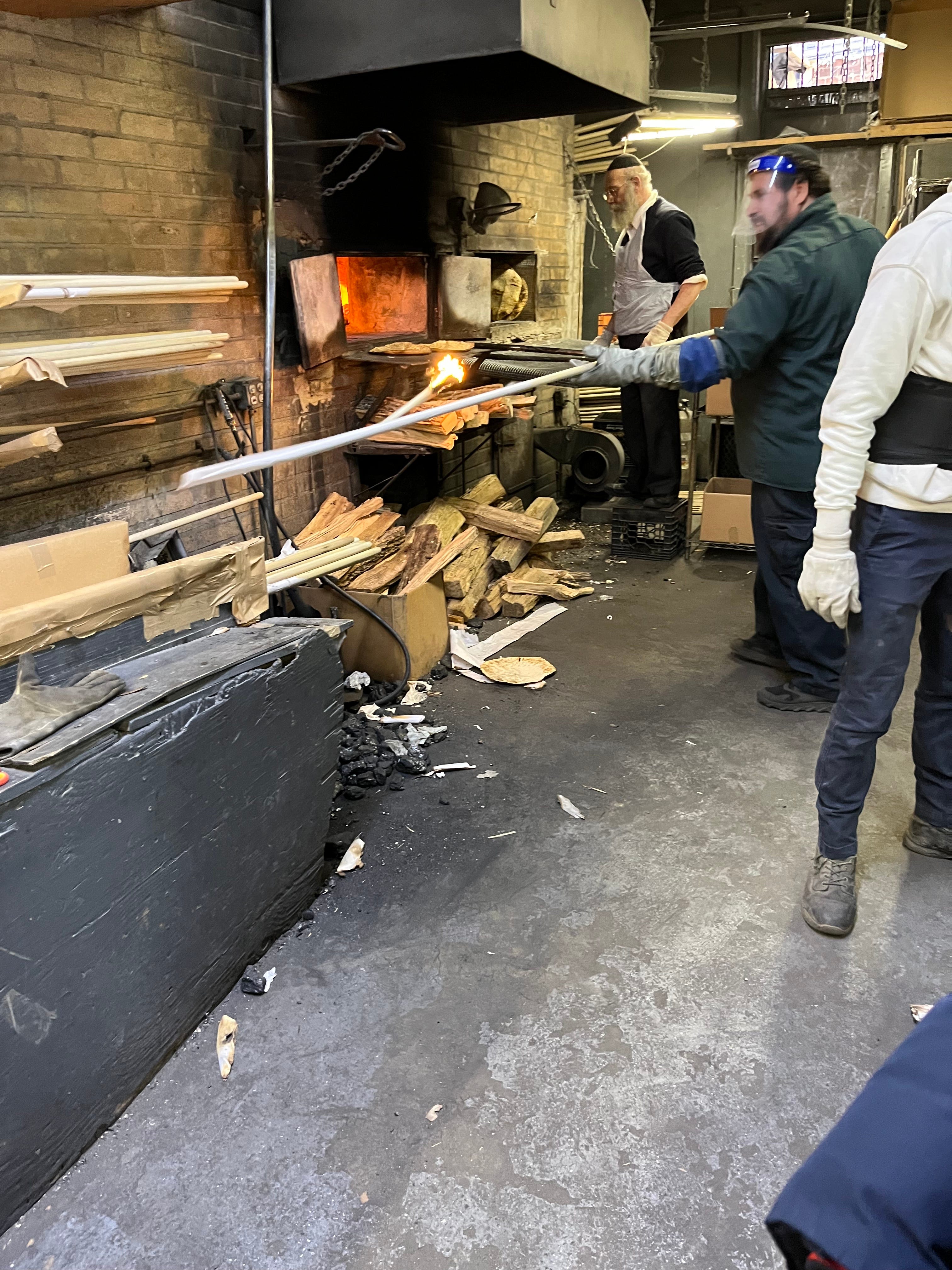
When the family finishes the baking for the day, their Matza is placed into a sealed container to keep it safe for Pesach.
This is why hand-made Matza is called “Shmorah Matza,” literally, “Guarded Matza.”
Every single step of the Matza-making process must be guarded with the utmost vigilance.
The question is, why?
As someone who had grown up hating the restrictions of Pesach, it took me a long time to understand why religious people take Matza so seriously. It’s just flour and water.
But that’s exactly why they do it.
Matza is food. It is the epitome of food. It is the Platonic Form of form.
Flour and water. That’s it.
The rabbis teach that there are some things so fundamental to the universe that they actually pre-date creation. These are things like Torah, Shabbos, and Moshiach.
And Matza.
Matza is the simplest thing that a person needs to survive. One could live their entire life on Matza alone. It would be bland, but it can be done.
The Pesach holiday gives us eight days to remember this fact, to remember that life is simple and can be lived on Matza alone.
Chametz, leavened bread, is nice, but not necessary. We prefer chametz to Matza, so much so that we are willing to pay exorbitant prices for fresh baked bread outside of Pesach, but we would never eat the cheap matza alternative if we didn’t have to.
Chametz is unnecessary.
But how much of our lives is Chametz? How much of our lives is dedicated to the pursuit of the things we want, not the things we need?
The nice car, the bigger house, the cooler parties – all of these things are chametz.
And our pursuit of these things makes us unhappy in the long-run.
Since October 7th, I have found myself living with less and less chametz in my life.
And not by choice.
The parties I liked to go to have quietly excluded Zionists. The places where I liked to read poetry have loudly excluded Zionists. Even the professions I wanted to pursue have excluded Zionists.
While all of these things have been painful, none have been life-threatening.
They were way-of-life threatening.
My way-of-life was quite decadent by Pesach standards, and many of the decadent aspects of secular western life that I enjoyed have slowly disappeared because of my choice to be a Zionist.
As I eat my Matza this week, I have found myself reflecting on that.
Matza, I realized, is the bread of Zionism.
It is the hurried food you make as you flee your home and travel to the unknown. It is the simple bread you bake when you arrive in a desolate land with nothing. And it is the bread you eat when your passion for Israel is greater than your desire for Chametz.
A lot of Jews are terrified about what is happening in their countries, but they are afraid to move to Israel.
Some are scared of the possibility of missile attacks, but many are more concerned about the certainty of scarcity.
Israel is not a land of ease.
Her homes are made of reinforced concrete. Her fields only yield their wheat to extreme sweat. Everything is hard.
Life in the west, even with all of its antisemitism, is easy.
We have packages that arrive at our doorsteps and meals that arrive fully cooked.
But Matza reminds us that we don’t need any of that, we just want it.
But what do we need?
Do we need the nice amenities of western life? Or do we need the freedom we can only feel in Israel?
Ultimately, it is up to each of us to determine what it is that we need and what it is that we want, and the Pesach holiday only gives us 8 days to reflect on this.
At the end of Pesach, we will return to eating chametz and our lives of relative luxury. We could easily avoid asking ourselves these questions again until next Pesach, but we shouldn’t.
We should ask ourselves who we are, and what we need, and what we want.
We should take this time to reflect upon the bread of affliction that predates creation, the journey of the Israelites from Egypt to the Promised Land, and where we are today as Jews.
Matza is a miracle whose simplicity must be guarded with the utmost scrutiny. Our lives are also a miracle of simplicity, though we are quick to overcomplicate them with chametz.
Pesach reminds us that life can be stripped down, that much of what we chase is not necessary, and that freedom sometimes asks us to leave comfort behind.
It reminds us that what we need is simple, but what we want is not.
Chag Sameach
~
Spread Love, Spread Light,
Am Yisrael Chai
If you enjoy our work and would like to support young Zionist voices, please consider upgrading to a paid subscription. Your support allows us to keep The Zionist Voice alive.
Yasher Koach Ted! Another excellent piece! Chag Samaech.
Your statement “When I was younger, I didn’t understand Matza. I still don’t, but at least know I understand that I don’t understand.”—how funny!!