

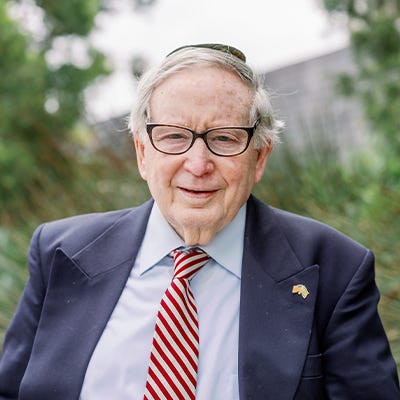
(Yossi Dresner, Z”L)
“Again with the no Kippah?!”
Yossi’s voice bellowed after my friend and I as we ran through the synagogue.
Yossi was one of those men who was about 4 feet tall, but he seemed to tower over everyone else in the room.
He had short white hair, small warm eyes, and he always wore a smile, wherever he went, except when he was yelling at us for not wearing a Kippa.
He was the synagogue’s “Ritual Director,” but he was so much more than that.
His formal responsibilities was running the daily minyan. As fewer and fewer people went to minyan every day, Yossi’s minyan remained. It was the last non-Orthodox daily minyan in the valley.
And it ran, on time, every day that Yossi was alive. 7:30 in the morning, and 5 or 6 at night, depending on daily light savings.
In the more religious world, they call the person who did what Yossi did the “Shamash,” or “the sun.”
Yossi was as consistent as the sun.
More consistent, actually. Rain never stopped Yossi.
He was an old man by the time I knew him, in his 70s. He was born in Israel just before Independence, and he served as a paratrooper in the 1956 War.
His love for G-d and his love for Israel touched everything he did.
As a child getting yelled at, I didn’t always know that. I understand it now.
I got to know Yossi better as an adult, when I started becoming more religious. I began attending his minyan, and, despite being younger than everyone else by at least three decades, I quickly became one of the crew.
Most people in the community only came to the minyan when there was a life event. Sometimes to celebrate a Bar Mitzvah or wedding, but usually to mourn a loved one.
It was a great comfort to know that Yossi would always be there, with his minyan, whenever the community needed it.
But Yossi didn’t do what he did for the community, he did it for G-d.
In a world increasingly uncomfortable with the divine, Yossi wore his faith proudly on his sleeve. He was not Orthodox; he was even known to love the occasional McDonald’s vanilla milkshake, but he was serious.
He was serious about G-d, and he was serious about Judaism.
Serious enough to be the last person in the community to complain when kids forgot their kippot.
When my mom asked him why he still did all of the things he did, even in his 80s, he said, in his warm Israeli accent:
“I can’t help it – I just believe.”
It was not until I spent time in the Orthodox community that I understood how lucky I was to have a person like Yossi in my community. There are plenty of people who follow Judaism for plenty of reasons, but there are very few people who have as pure and as joyous a faith as Yossi.
When Yossi davened Kabbalat Shabbat, I felt as though I was transported through time, into the world of the prayers.
As Yossi sang, in the beautiful Hebrew:
“Adonai sat enthroned at the Flood;
Adonai sits enthroned forever,”
I felt like I was there, at the flood, with Yossi. Yossi’s eyes were closed, G-d sat upon his throne, and Yossi was singing.
תהילים כ״ט:י׳
יְ֭הֹוָה לַמַּבּ֣וּל יָשָׁ֑ב וַיֵּ֥שֶׁב יְ֝הֹוָ֗ה מֶ֣לֶךְ לְעוֹלָֽם׃
Psalms 29:10
GD sat enthroned at the Flood;
G-D sits enthroned, ruler forever.
The closer shabbat came, the closer I felt to G-d. With each passing prayer, with each word from each psalm, I felt like I was getting closer and closer to shabbat.
They say that the shabbos angels accompany a man on his way home from shul, singing along with him as he hums the tunes he remembers.
If that’s true, those angels learned how to sing from Yossi.
When the monsters and demons of October 7th invaded our homes, Yossi hung an Israeli flag over a chair.
A darkness hung over Yossi from that day until the day he died.
But minyan never started late.
No matter what was going on in the world, Yossi’s minyan was meeting at 7:30 in the morning and 5 o’clock at night.
After praying one evening, I walked Yossi to his car. He walked out of the shul, kissed the mezuzah, and took a deep breath.
He smiled and said, “ahh, spring time, the air just smells beautiful, you know?”
Yes Yossi, I know.
I know because you taught me how to smile at the world.
Yossi never taught me formally, but he taught me by example.
He knew Torah, but he would balk if anyone ever compared him to a Rabbi.
He taught me how to treat people, how to treat the Torah, and how to treat G-d.
Today, we will inaugurate a new Torah scroll in his honor. It will sit in the hall where he led minyan all these years.
The great rabbis teach us that Moses was never buried, but his body was interred within the Torah, and every time a soul reads a word of Torah, it is as though they are leaving a stone upon the grave of Moshe Rabbeinu.
I cannot help but think that Yossi is buried there too.
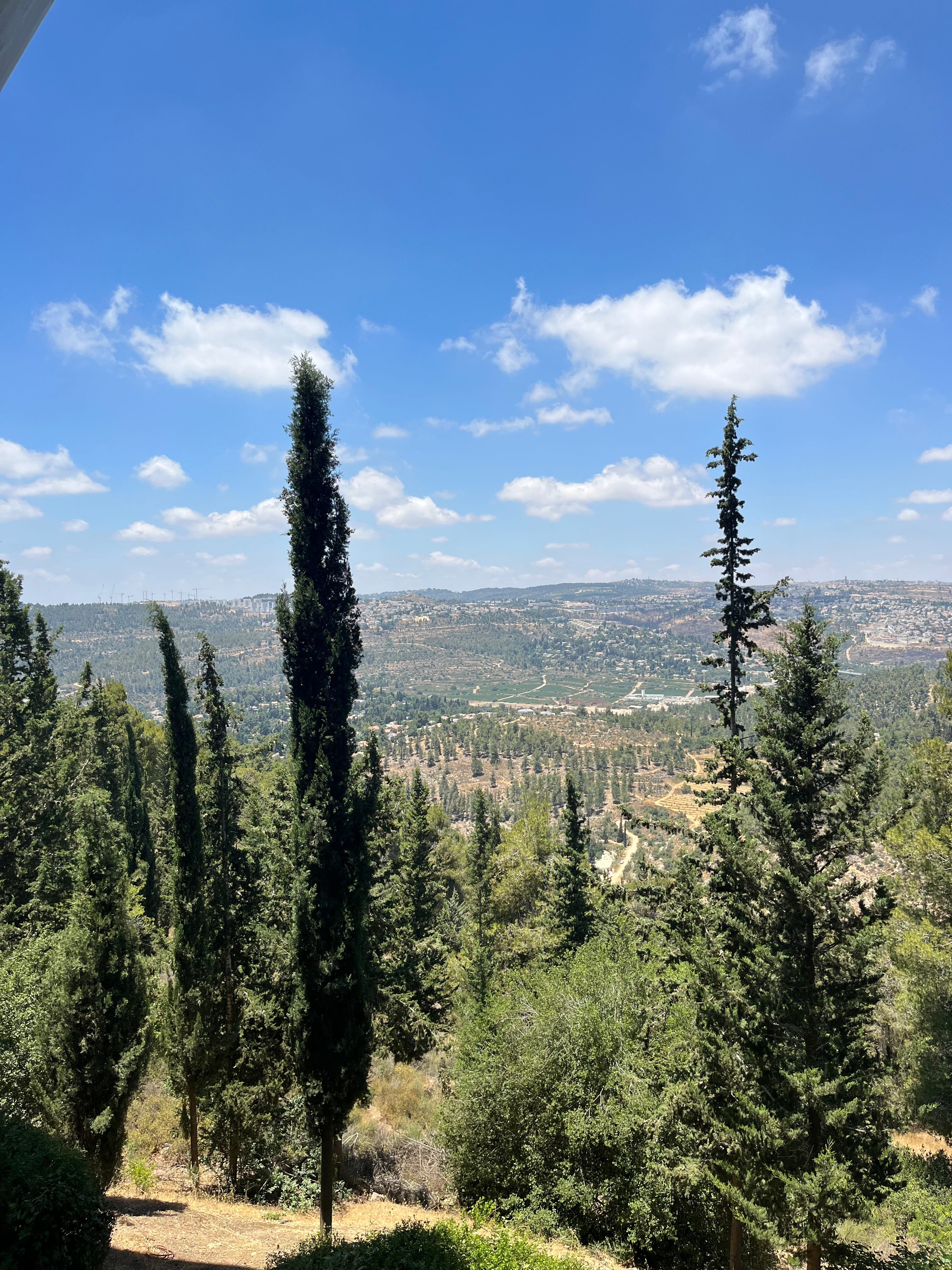
The last time I talked to Yossi, I asked him for a blessing.
I was going to Jerusalem to study Torah, and I wanted him to give me a formal blessing, the ancient kind, with his hands upon my head.
But that was not Yossi’s way.
Yossi gave me his own blessing, to learn well and come back and teach them what I learned.
“And where are you going to be?” He asked.
“In Yerushalayim.” His face opened up into a big smile.
“Ahhhh, Yerushalayim. You know, my whole life, I’m Tel Aviv. But, Jerusalem, you know,” he paused and took a deep breath, “there is just something about the air there, it’s so special. You can smell it when you’re on the bus coming up from Tel Aviv. Oh, Jerusalem.”
Those were the last words Yossi ever said to me.
“Oh, Jerusalem.”
With a big smile on his face.
When Yossi ran his afternoon minyan, he would always teach a little Torah in between Mincha and Maariv. One is the afternoon prayer service, and one is the evening prayer service.
He would teach a little Torah, we would say Kaddish d’Rabbanan, a prayer for Israel, then Hatikvah, and then we would move into Maariv.
This was Yossi’s tradition. He also had a tradition that, after prayers were concluded and the announcements were made, he would say, “Enjoy Life. G-d bless the United States, G-d bless Israel, and G-d bless you all.”
And we would all respond, “And G-d bless Yossi!” He hated that, but he didn’t stop us.
While I was in Jerusalem, I studied a section of Talmud about minyan times.
The rabbis were arguing about whether or not one can pray Mincha right before sunset and then Maariv right after, as we had done in the Yossi minyan!
I became very concerned.
Was it possible that Yossi’s minyan was actually a violation? Was he not allowed to have a Mincha/Maariv minyan held together?
Well, according to Rabbi Yehuda, one can pray one service after the other IF one makes a clear and substantial separation between the two.
But what constitutes a clear and substantial separation?
If one has enough time to teach a Torah lesson in between, that counts as a substantial separation.
Ah, but what counts as enough Torah to be a Torah lesson?
If you teach enough Torah that you have to say Kaddish d’Rabbanan after.
I looked up from my Talmud and smiled.
Here I was, sitting in Jerusalem, 7000 miles away from Yossi, realizing just how brilliant he was. This wasn’t his tradition – this was an ancient tradition, codified in the Talmud.
I was excited to tell Yossi that the jig was up, and I knew what he was doing, but I never got the chance to.
When I returned to Los Angeles after that trip, I went back to his Minyan.
Nothing had changed. It was the same group of people, at the same time, in the same room, like always.
When I walked in, all of my old friends smiled and rushed to greet me. I took my seat and began davening.
After Mincha, the leader asked me if I had learned any Torah in Jerusalem that I wanted to share.
I shared that lesson about Rabbi Yehuda, and I talked about how Yossi had quietly tricked all of us into following the Talmudic law without ever mentioning it.
I had forgotten that Yossi had asked me to come back and teach what I had learned. I forgot that until just now. But I guess that was just Yossi’s way. Everything was so subtle, so humble. He gave me a blessing that I wasn’t expecting, and it came true. And now we’re both smiling about it.
I have this silly little dream that, one day, I’ll be sitting in shul, and I will see a little boy running by, and I will get to yell at him, “again with the no Kippa?”
It is a strange aspiration I know, but it is one I have nonetheless.
With everything going on in the world, all of the war, all of the hatred, all of the confusion and all of the anger, I find myself asking, “what would Yossi do?”
“What would Yossi say if I was talking to him right now?”
But I know exactly what he would say.
He would say: “Minyan is at 7:30 and 6 o’clock. We pray here, every day. Enjoy life. G-d bless the United States, G-d bless Israel, and G-d bless you.”
And G-d bless you, Yossi, wherever you are.
~
Spread Love, Spread Light,
Am Yisrael Chai
A lovely piece. Kol hakavod.
I can hear him saying that exactly. May Yossi’s memory forever be a blessing.