

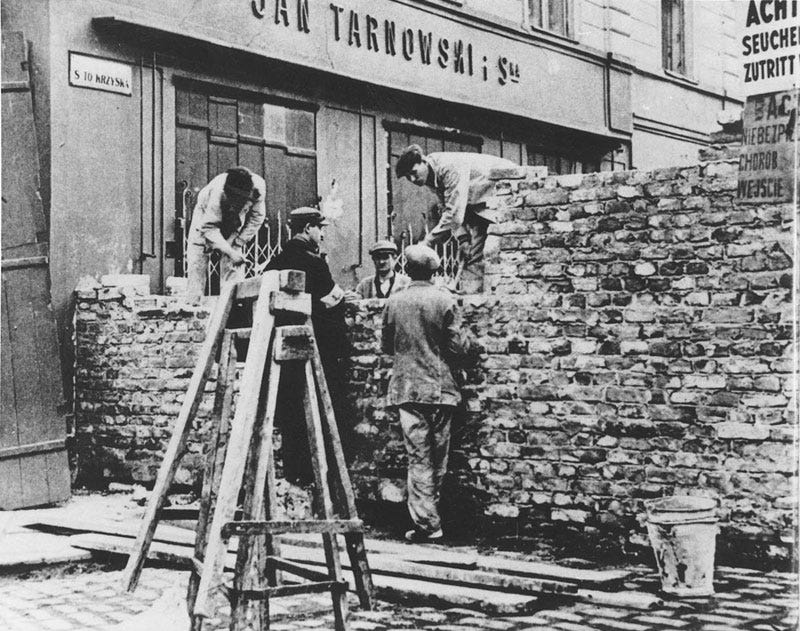
(Construction of the walls of the Warsaw Ghetto)
In every city that Jews have ever lived in, there are always two Jewish neighborhoods: the old one, and the new.
Jews flock to cities that welcome them. They lay down roots, they work hard, they build synagogues and cultural institutions, they establish themselves, and then they move. They don’t leave the cities altogether; they just move to a different part.
The first Jews to come to Los Angeles established themselves in Boyle Heights, and there are next to no Jews there anymore. In New York, the Jews first landed on the Lower East Side, way before it was trendy, back when it was five-story walk-up tenements, everyone living cheek to jowl. Today, they live uptown. Where they may end up next is anybody’s guess.
No matter where Jews live, they are never fully planted there. Rather, they are always ready to uproot themselves and move to greener pastures.
The United States has been the Jewish neighborhood of the West for quite some time now. The first Jewish enclaves in America pre-dated the Revolution by a century. Jews have lived here in relative comfort for going on four centuries now, a veritable epoch in the long history of Jewish exile.
But, as with every great city in the world, the Jews are never fully secure, even in the great City on a Hill that is the United States.
For many decades, it was liberal cities that welcomed Jews the most. New York and Los Angeles, Chicago and Miami, St. Louis and Baltimore – these were the places the Jews were most welcome.
But all men of reason can see that trend is changing. The prevailing winds of liberal politics are pointing in a distinctly antisemitic direction. These cities are filled with signs that say “Zionists not welcome,” and all men of reason know that Zionist is just another word for Jew. The Zionists are not welcome at their concerts, their college campuses, and certainly not their Christmas parties.
Some of these Jews have chosen and will continue to choose to make Aliyah. Some of them have invested in a mortar and pestle, so they can grind their Ambien into a fine powder to mix into their afternoon cocktails. And some of them will move to new cities, more conservative cities, cities that, at least for the time being, seem more welcoming than their liberal counterparts.
But all of them make these choices because, whether they realize it or not, they are living in the New Ghetto.
The New Ghetto is digital rather than physical. It exists all around us, subtly affecting every element of our lives. It makes itself known to us when we skip songs in our shuffles that we used to listen to religiously, when we avert our eyes from “Free Palestine” graffiti on our daily walking routes, when we get into petty fights with one another about which political choice is the lesser of two evils.
The New Ghetto is so all-encompassing that it is almost impossible to see from within. Like a lobster being boiled alive, we barely notice the temperature rise.
There are many responses to the ghetto. Some try to fight it, some try to flee it, and some try to live with it.
If you are reading The Zionist Voice, you are likely in the fighting camp.
It is three years after October 7th. The world will never be the same. We are living in a new ghetto, and to address it we need new strategies, new institutions, and new leaders. The way we operated in the old world will not work now. The first step we all must take is acceptance. We cannot devise a strategy for a world we refuse to admit exists. After that, we can get on to planning for the fight ahead.
More to come.
~
Spread Love, Spread Light,
Am Yisrael Chai